
Farewell Dickie Bird, legendary umpire and national treasure - Chris Waters
THE abiding memory will be of a man in a white coat, fidgeting nervously, periodically scanning the skyline for any sign of precipitation and/or approaching bad light, while routinely rejecting appeals for leg-before wicket unless they were plumb.

“Howzat?”
“Not out,” would come forward the shout, perhaps with a helpful gesture that the ball - in the opinion of the world’s greatest umpire - was just going on to slide past the stumps.
And no matter how great the bowler, or how big his celebrity, the verdict would always be taken with good grace.


For no one ever really questioned Dickie Bird, or argued with him; why, to do that would have felt like talking back to your granddad or favourite uncle.
Harold Dennis Bird, who has died aged 92, peacefully at his home in deepest south Yorkshire, was perhaps not the greatest umpire that the world has ever seen - there is, after all, no accounting for taste - but he was certainly the most well-known, a man whose fame transcended both the confines of his office and the game in general.
Housewives might not have heard of Martyn Moxon, for example, or Chris Old, or Paul Jarvis, to name but a few of the Yorkshire players who represented England when Bird was an official, but they had assuredly heard of the man behind the stumps, a man whose upraised right index finger was not easily won during the hard-fought battles between bat and ball.
Dickie was a renowned “not-outer” in the days before technology, an umpire who tended to give batsmen the benefit of the doubt. “The laws state that I have to be certain,” he once protested. But still the best rated him as the creme de la creme: Sobers, Botham, Lillee, et al.
He was, in many ways, an on-field man-manager, an ex-player who intuitively identified with the players.
As Dennis Lillee observed: “He has a genuine understanding of the people he is controlling. He knows when to talk to players, when to joke with them and how to discipline them. But, above all, his ability to make the correct decision is second to none.”
Born in Barnsley on April 19, 1933, and determined that he would not follow his beloved father to a life down the pit, Bird was gifted at cricket and football but had to forgo the latter due to a knee injury.

One of his childhood friends was Tommy Taylor, the England and Manchester United centre-forward, who died in the Munich air crash of 1958.
Two years earlier, Bird had made his first-class debut for Yorkshire as a right-hand batsman, but he managed only 14 first-class appearances for the club in the course of four seasons.
He was a very decent player, but not quite decent enough to command a regular place in a side that would go on to dominate county cricket, his plight evidenced when he was dropped immediately after scoring a career best 181 not out against Glamorgan at Bradford in 1959 because bigger names were then available to play.
Still he regarded his decision to leave Yorkshire that year as an error, admitting: “It was a massive mistake. Probably the biggest I ever made. But I had reached the end of my tether. I felt I just couldn’t take any more knock backs.”

So he went off to Leicestershire, scored more than 1,000 runs in his first season and was awarded his cap, only for the appointment of a new captain, Maurice Hallam, to send his fortunes spiralling down the pan.
“He didn’t much care for Yorkshiremen,” recalled Bird, “because the England selectors, in their wisdom, had picked Yorkshire’s Ken Taylor rather than him.” Bird stuck it out until 1964 when he played his last first-class game, after which he spent a few years coaching in Devon and playing cricket for Paignton.
Serendipity began Bird’s second career as a world-famous umpire.
In 1969, when he returned to Yorkshire for the funeral of his father, he took in a match at Headingley and told former colleagues how much he was missing the first-class scene. The suggestion was put forward that he might like to put on a white cap and a white coat therefore, and within a year he was appointed to the first-class umpires’ list, standing in his first match in May 1970 when Nottinghamshire played Warwickshire at Trent Bridge, the great Sobers marking the occasion with an unbeaten hundred.
Bird’s first Test followed in 1973, when England beat New Zealand by an innings at Headingley, Geoffrey Boycott - once a team-mate at Barnsley CC, along with Michael Parkinson - marking that occasion with a century, too.
In total, Bird stood in 66 Tests, 69 one-day internationals and in four World Cup finals (three men’s, one women’s), fixtures coloured not only by great cricket but sometimes by burst pipes, bomb scares and reflecting windscreens, all adding to the pressure on the shoulders of poor Dickie, who had a habit of attracting minor incident wherever he went.
Never was the esteem in which he was held more obviously highlighted than when he received a guard of honour from the England and Indian players in his final Test at Lord’s in 1996, when he waved his hankie to the crowd as he dabbed away tears. Bird was always the most emotional of men; so much so, friends used to joke that his statue in Barnsley had rusted due to the droplets that dripped from its eyes.
It was the smile, however, that will be most remembered - beaming, infectious, as wide as an ocean at the slightest provocation. A fine sense of humour was never far from the surface, encapsulated when Bird lost one of his counting marbles during a game one day and was desperately scrambling around on his hands and knees in an effort to find them. “What’s up, Dickie?” asked one of the players. “Ave lost me marbles!” he replied. “Ave lost me marbles!” He had the ability to laugh at himself.
Once, turning to more serious matters, and the systematic erosion of umpires’ authority brought about by the advent of technology and a move towards a more professional era, he bemoaned that officials nowadays serve little function other than being able to count from one to six.
He was never a fan of DRS, of Hawk-Eye, or of any such aids; nor did he believe that neutral umpires were necessary, once arguing that “if I, as a proud Yorkshireman who desperately wants the county to do well, had to give a decision which settled Yorkshire’s fate, I would not worry for an instant”.
His greatest fear in life was not getting an umpiring decision wrong but turning up anywhere late.
If Bird had to be somewhere at 12.45pm, for example, as he had in 1986 when he went down to Buckingham Palace for his MBE, he would get up ridiculously early - on that occasion at 5am to catch the 6.02 train from Wakefield.
“I arrived at 8.40 and had to spend four hours sitting in a coffee shop round the corner,” he recalled. “It was worth it, though, to meet the Queen.”
Bird had the pleasure on numerous occasions; he met Her Majesty so often, in fact, that he was practically as much a part of the furniture down there as the royal corgis. He corresponded with the Queen, in fact, right up to her death in 2022.
As he recalled: “I got a letter from her about a week before she died. She just asked how I was, how my health was, how I was keeping. She was a wonderful woman, and I was very sad indeed when she passed away.”
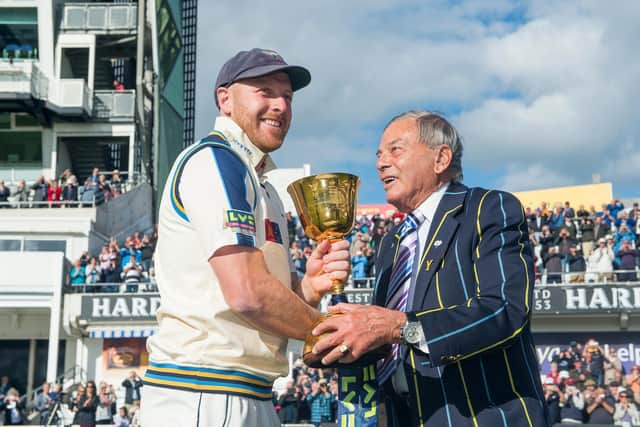
One of his proudest visits to the Palace came in 2014, when Yorkshire went down to collect the County Championship trophy in a year when he served as club president. He adored that role and especially travelling on the coach to games with the first-team squad.
His name lives on at Headingley in the form of the Dickie Bird players’ balcony, and also the Dickie Bird clock, while the Dickie Bird Foundation has done a huge amount of good work for disadvantaged youngsters.
A national treasure if ever there was one, Bird was liable to crop up just about anywhere and everywhere, appearing on This is Your Life, Desert Island Discs, and innumerable television shows.
His name adorned several books, his autobiography selling more than a million copies in both hardback and paperback, making it one of the biggest-selling sports books ever, another sign of his widespread appeal.
As well as the mistaken decision to leave Yorkshire as a player, Bird described his other great regret in life as having never got married, admitting that he wished he had a son who played cricket for Yorkshire. Instead, he was, first and foremost, married to cricket; why, if he could have given the game a big sloppy kiss and bought it some roses, no doubt he would have done.
Sir Michael Parkinson captured Bird’s love of the game as well as anyone. “To say Dickie Bird loves cricket doesn’t get anywhere near describing exactly what he feels for the game,” he wrote. “It’s a bit like saying Romeo had a slight crush on Juliet, or Abelard had a fancy for Heloise.
“The game consumes his life and defines its horizons. It shapes the very posture of the man. Like a tree bent and moulded by the prevailing wind, so the curve in his spine, the hunch of his shoulders, the crinkled eyes as he inspects the world, have been sculpted through a lifetime’s dedication to cricket.”
The renowned “not-outer” is now finally out. What a wonderful innings it was. Well batted, Dickie.