
Why I strongly suspect that President Zelensky’s days are numbered - Patrick Mercer
Ukraine’s struggles on the battlefield are well known and widely publicised. Even if Boris Johnson has decided that Britain and most European countries have tired of the war, polls show that well over 50 per cent of this country still agree with our efforts and expenditure to support Kiev.
But, whilst combat operations are hugely challenging for Ukraine, they are relatively easily understood and there’s no lack of analysis in the media. President Zelensky, though, now has troubles on the home front which for the first time are starting to throw doubt on his ability to continue to fight.
The first is the highly contentious matter of conscription. With the Commander in Chief, General Syrskyi, demanding 30,000 recruits every month simply to replace battlefield casualties, the conscription officers are having to resort to increasingly brutal methods to press men into service.
The government has recently reduced the age of conscription to 25 and increased it to 60.
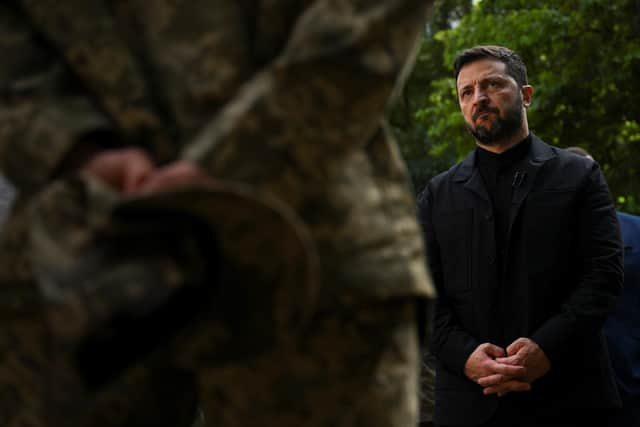

NATO nations have been putting increasing pressure on Kiev to reduce the age of conscription to 18, but it’s not as simple as that. Youngsters are needed to run the country - their aptitude for technology being particularly prized.
Now, that’s understandable, but it’s not widely understood that there’s a desperate shortage of 18-25 year old men in Ukraine caused not just by a falling birth rate, but also a mass exodus of lads to the West and Russia even before the fighting started. So, what few 18 year olds there are are carefully husbanded.
To compensate for this, the Territorial Conscription Centres (TCC) staff often grab likely candidates straight off the street, bundle them away in cars and vans and have them in uniform in the blink of an eye. Pirate videos showing the TCC’s barbarous methods make deeply shocking viewing with many young men holing up in flats and rooms indefinitely simply not daring to emerge in daylight.
To make things worse, Russia has grasped the deep resentment felt by many people towards the TCC and, with typical cynicism, has sought covert information about the location of TCC offices, accommodation and the like from a population that’s increasingly hostile toward the press gangs. With accurate details being passed by disaffected Ukrainians, it’s been simple enough for the Kremlin to aim missiles and drone attacks at the recruiters.
For Russia this is a win-win. TCC officers have to operate openly, so a precise strike which kills or injures them and destroys their vehicles and accommodation not only seriously hampers recruitment, but also has the tacit support of even loyal Ukrainians.
Russia has made many tactical and even strategic mistakes, but this is a genius piece of asymmetric warfare which has meant that many Ukrainian units are now complaining of grievous manpower shortages. Psychologically it’s also been deviously clever: many citizens are now applauding the Kremlin’s attacks on the hated TCC.
But, whilst this is a serious problem, it is nothing when compared to the demonstrations against President Zelensky that are sweeping many of the big cities. Now, no matter how much you believe in the righteousness of Ukraine’s cause and admire her courage, the country’s reputation has always been marred by ingrained and ever present corruption.
It’s a small thing, but I can remember how shocked I was when I had to part with $25 as a bribe to a policeman in Kiev who, supposedly, had caught me jaywalking. I soon got used to such petty graft, but my experience was trifling when compared to the endemic corruption which still stains Ukrainian society even in times of war.
To combat this and demonstrate a fresh start after the EuroMaidan Revolution in 2014, the National Anti-Corruption Bureau (NABU) and the Special Anti-Corruption Prosecutor’s Office (SAPO) were established with complete independence. Their record over the last decade has been patchy, but they were viewed by many as crucial planks that point towards a brighter future.
Unsurprisingly in wartime, President Zelensky and his party have gained significant control over the state’s machinery, but when laws were passed a few days ago which heavily curtailed the independence of both agencies, the government was shocked by the people’s violent reaction.
Across the country large numbers of folk took to the streets, including many uniformed soldiers (even recuperating wounded on crutches could be seen), causing the EU and NATO to show their displeasure. Then, with suspicious haste, the legislation was withdrawn, but to no avail as the demonstrations continued.
The official reason for bringing both agencies under closer government control was that covert Russian influence within them needed to be rooted out. This doesn’t stack up, though. In fact, NABU and SAPO had begun scrutinising several officials close to the president and his inner circle.
The difficulty for Mr Zelensky is that one of his key promises when he was elected in 2019 was to strangle corruption. But now passing legislation that allows him and his cohort to escape being investigated for the very thing he’s sworn to stop seems to have crossed the reddest of red lines.
I strongly suspect that President Zelensky’s days are numbered and I base that on the recent behaviour of his most probable successor, General Valeri Zaluzhnyi, currently Ukraine’s ambassador in London. This old warhorse has suddenly been the subject of a Vogue makeover and photoshoot. Gone is the combat suit and buzz cut hair: now it’s Armani and designer stubble: never has vaulting ambition been so clearly defined.